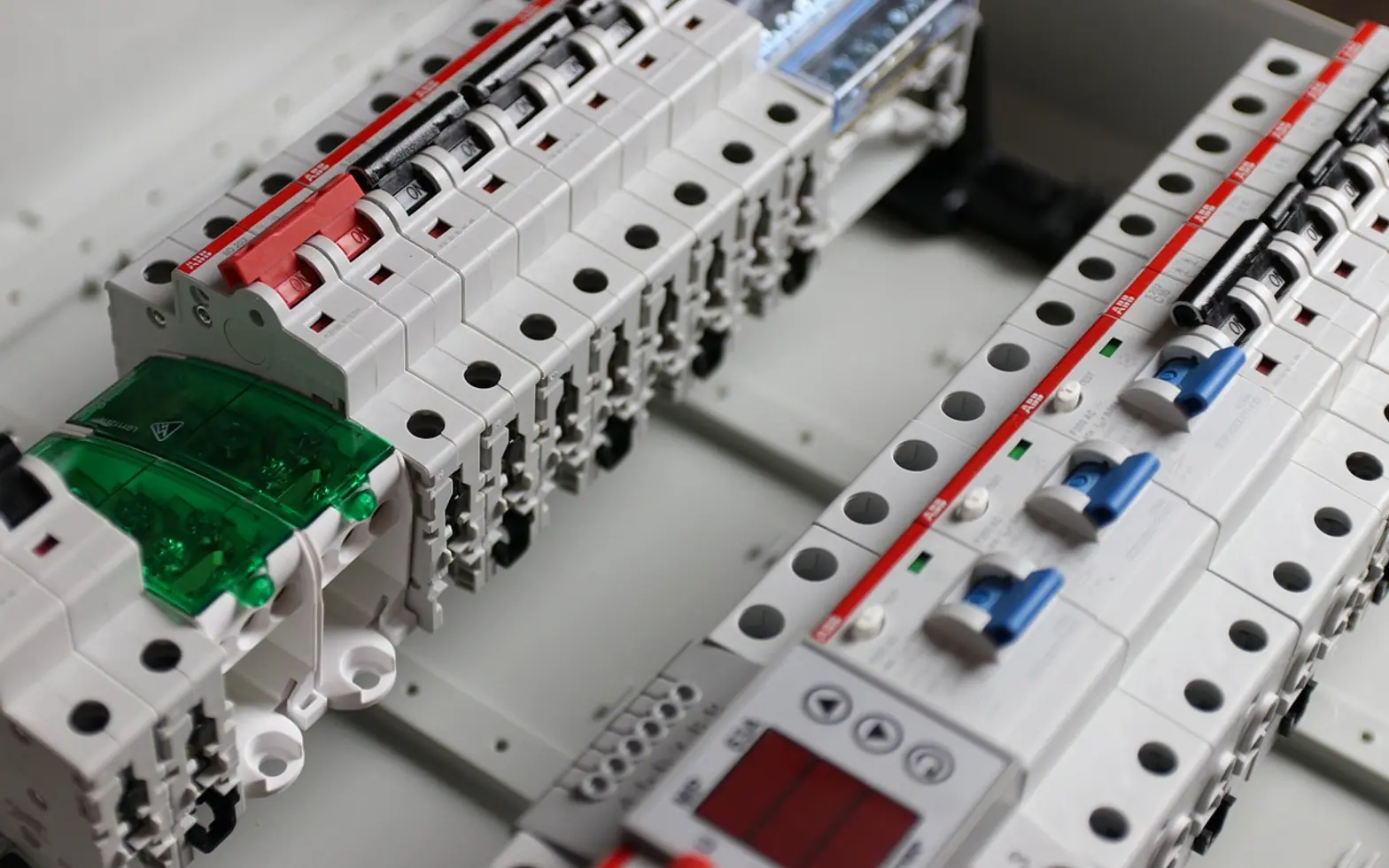
A PLC, or programmable logic controller, is a rugged industrial computer that controls machines and processes. It reads signals from sensors and switches, decides what should happen according to its program, and switches motors, valves, heaters and lights in response — over and over, many times per second. If a factory line, a packaging machine or a water pumping station runs automatically, there is a good chance a PLC is in charge.
Where PLCs came from
Before PLCs, machine logic was built from banks of electromechanical relays wired together by hand. Changing how a machine behaved meant rewiring cabinets, which was slow and error-prone. The PLC replaced that wiring with software: the same hardware could be reprogrammed for a new product or sequence. Its programming language was even designed to look like relay wiring diagrams, so electricians could pick it up quickly.
The parts of a PLC
- CPU: the processor that runs the program and keeps track of the machine's state.
- Input modules: receive signals from push buttons, limit switches, proximity sensors, temperature probes and similar devices.
- Output modules: switch contactors, solenoid valves, indicator lamps and motor drives.
- Power supply: converts mains power into the low voltage the controller needs.
- Communication ports: connect to other controllers, operator screens and supervisory systems over industrial networks.
How a PLC works: the scan cycle
A PLC does not wait for events the way a desktop program might. It repeats a fixed loop called the scan cycle:
- Read inputs. It takes a snapshot of every input signal.
- Execute the program. It works through its logic from top to bottom using that snapshot.
- Update outputs. It switches outputs on or off according to the results.
- Housekeeping. It handles communication and runs internal diagnostics.
Then it starts again. Because each cycle is short and consistent, the machine reacts predictably — an essential property when a mistimed valve or a late stop signal could damage equipment or hurt someone.
PLC programming languages
The international standard IEC 61131-3 defines several languages, and many controllers let programmers mix them:
| Language | Looks like | Often used for |
|---|---|---|
| Ladder diagram | Relay wiring drawn as "rungs" between two rails | Discrete on/off logic, interlocks, maintenance-friendly code |
| Function block diagram | Connected blocks, like a circuit schematic | Process control, timers, PID loops |
| Structured text | A text language similar to Pascal | Calculations, data handling, complex logic |
| Sequential function chart | A flowchart of steps and transitions | Batch processes and machine sequences |
A fifth, list-style language called instruction list was part of the standard but has been deprecated, and newer projects rarely use it.
Types of PLC
Compact (fixed) PLCs
Processor, inputs and outputs come in a single unit. They suit small machines with a known, limited number of signals.
Modular PLCs
Separate modules clip onto a rail or backplane, so input, output and communication cards can be added as a machine grows.
Safety PLCs
Built with redundant processing and self-checks, they handle emergency stops, light curtains and guard doors, and are certified for safety functions.
Where PLCs are used
- Production lines in food, drinks and packaging — the kind of machinery described in our look at modern pasta factory equipment.
- Plastics processing, where they sequence clamping, injection, cooling and ejection on injection moulding machines and control parison timing in blow moulding.
- Water and wastewater treatment, pumping stations and building services.
- Conveyors, sorting systems and warehouse automation.
- Traffic signals, lifts and car park barriers.
PLC vs other controllers
Against a microcontroller board: a hobby board is cheap and flexible, but a PLC is built for electrical noise, vibration, wide temperature ranges and years of continuous operation, with certified input and output circuits and long-term spare-parts support.
Against an industrial PC: a PC handles heavy data processing and graphics well, while a PLC excels at deterministic, real-time control. Many plants use both, with the PC or an edge device collecting data and the PLC running the machine — see our guide to edge computing versus the cloud for how that data is used.
How PLCs fit into the wider system
A PLC rarely works alone. Operators interact with it through an HMI (human-machine interface), usually a touch panel next to the machine. Across a whole plant or utility, a SCADA system gathers data from many PLCs, shows alarms and trends, and lets supervisors adjust settings remotely.
Common beginner questions
Do you need to be an engineer to program a PLC?
Basic ladder logic can be learned with training software and a small starter controller. Work on real machines, especially safety functions, should be done or checked by qualified people because mistakes can cause injury or damage.
Are PLCs being replaced by cloud software?
Not for direct control. Machines need instant, reliable decisions on site. Cloud and edge systems add analysis on top, while the PLC keeps doing the real-time work.
Tell us what you think.
Corrections are always welcome.