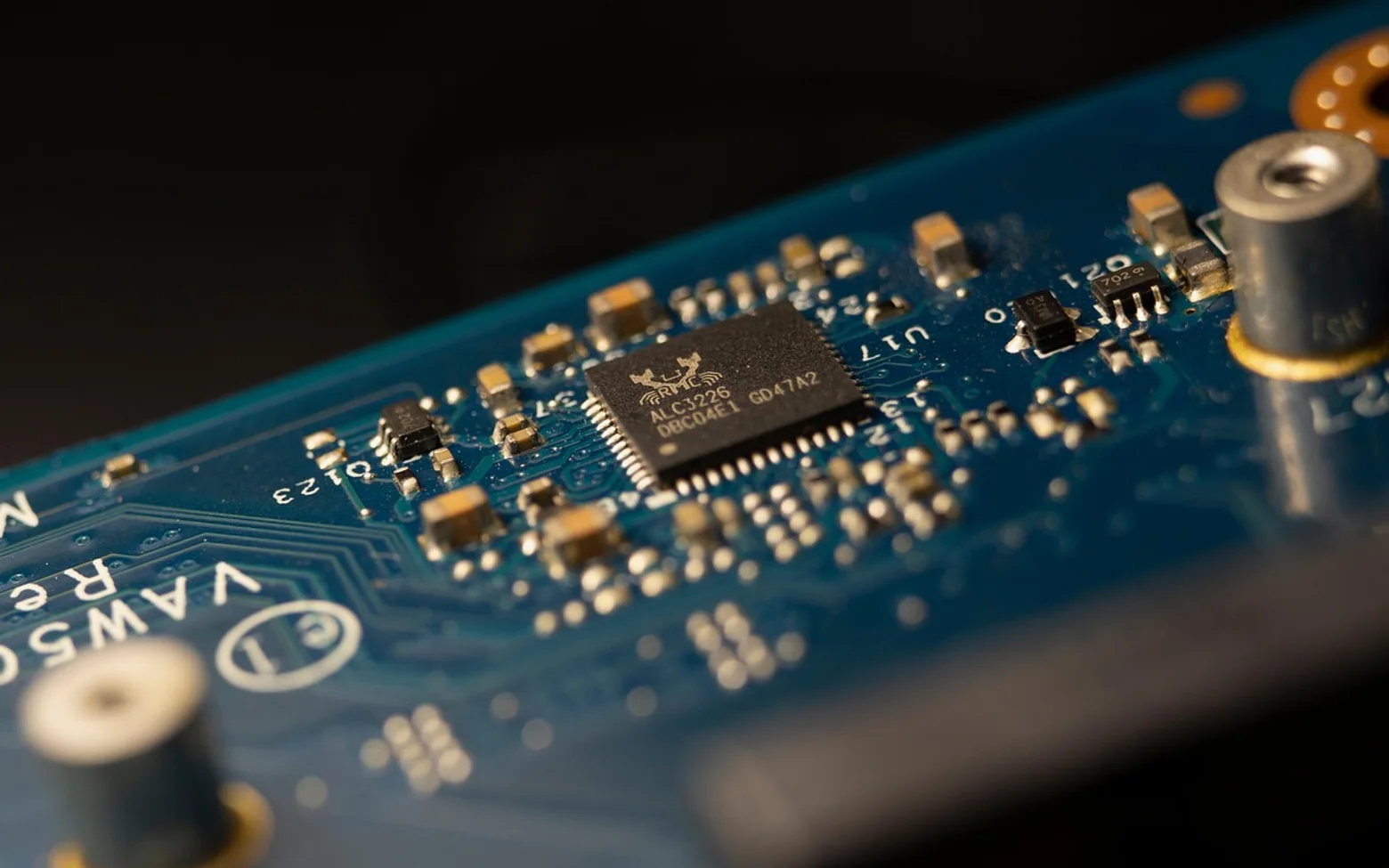
A semiconductor is a material whose ability to carry electricity sits between a good conductor, such as copper, and an insulator, such as glass. More importantly, that ability can be controlled — by adding tiny amounts of other elements, by applying a voltage, or by shining light on it. That controllability is what makes switches, amplifiers and memory possible, and it is why the word "semiconductor" has become shorthand for the chips inside almost every electronic product.
Conductor, insulator, semiconductor
In a metal, some electrons move freely, so current flows easily. In an insulator, electrons are tightly bound and very little flows. A semiconductor has a modest energy gap — the band gap — that electrons must jump to start conducting. Small inputs of energy or small changes to the material decide whether they make that jump, which turns the material into something engineers can steer.
Doping: the trick that makes it useful
Pure silicon is not very useful on its own. Manufacturers deliberately add trace amounts of other elements, a process called doping:
- N-type silicon is doped with elements such as phosphorus that add spare electrons, which carry negative charge.
- P-type silicon is doped with elements such as boron that create "holes" — gaps where an electron is missing — which behave like positive charges.
Where n-type and p-type regions meet, a p-n junction forms. It lets current pass easily in one direction and blocks it in the other. That single structure is the basis of diodes, solar cells, light-emitting diodes and, combined in more elaborate ways, transistors.
Why transistors matter
A transistor is a semiconductor switch: a small voltage on one terminal controls a much larger flow between two others. Switched on and off, transistors represent the ones and zeros of digital logic. Wired together by the millions or billions, they form processors, memory and controllers. Modern chips pack them so tightly that individual features are far smaller than a virus.
Common semiconductor materials
| Material | Typical uses | Why it is chosen |
|---|---|---|
| Silicon | Processors, memory, most chips, solar cells | Abundant, well understood, forms a stable oxide layer |
| Germanium | Some high-speed and optical components | Historic first transistor material; good carrier mobility |
| Gallium arsenide | Radio-frequency parts, some lasers | Fast and efficient at high frequencies |
| Gallium nitride | Compact chargers, LEDs, power electronics | Handles high voltages and heat in a small package |
| Silicon carbide | Electric-vehicle inverters, industrial power | Tolerates high temperature and voltage |
The coloured light in gaming keyboards and fans also comes from semiconductors: every LED is a p-n junction that gives off light. Our guide to RGB versus addressable RGB lighting shows how those diodes are controlled.
How computer chips are made
Chip fabrication is one of the most precise manufacturing processes in existence. In simplified form:
- Purify the silicon. Silicon is extracted from quartz sand and refined to extremely high purity.
- Grow a crystal. The molten silicon is drawn into a large single-crystal cylinder, called an ingot.
- Slice and polish wafers. The ingot is cut into thin discs and polished to a mirror finish.
- Build layers. Thin films of insulating and conducting materials are deposited onto the wafer.
- Pattern with light. In photolithography, a light-sensitive coating is exposed through a mask so that a circuit pattern can be transferred onto the wafer.
- Etch and dope. Unwanted material is etched away and selected areas are doped, often by firing ions into the surface.
- Repeat. Steps four to six are repeated many times to build up transistors and the metal wiring that links them.
- Test, cut and package. Each chip on the wafer is tested, the wafer is diced into individual chips, and the good ones are mounted in protective packages with connections to the outside world.
All of this happens in cleanrooms, because a single speck of dust can ruin a circuit. That precision, the cost of the equipment and the long list of specialised suppliers are why chip production is concentrated in relatively few places.
Semiconductors beyond computers
- Power electronics in chargers, motor drives and the systems that manage battery flow in electric cars, including regenerative braking.
- Sensors for light, temperature, pressure and motion.
- Solar panels, which turn light into current through p-n junctions.
- Communications chips that drive mobile networks and Wi-Fi.
- Edge devices that process data where it is collected, explained in our piece on edge versus cloud computing.
Frequently asked questions
Is a semiconductor the same thing as a chip?
Not strictly. The semiconductor is the material; a chip, or integrated circuit, is a device built from it. In everyday speech the terms are used interchangeably.
Why is silicon used instead of a better-performing material?
Silicon is plentiful, works well across a wide range of temperatures and forms a reliable insulating oxide. Decades of manufacturing know-how also make it far cheaper to process at scale than most alternatives.
What is the difference between a chip designer and a chip maker?
Many companies design chips but do not own factories; they send their designs to specialised manufacturers, often called foundries, which produce the wafers.
Tell us what you think.
Corrections are always welcome.